

ReSPA and Italian Partners Strengthen Senior Public Leadership through Capacity Building and Mobility Programme 3.0
24–25 June 2026, Rome, Italy
ReSPA, in partnership with the Italian National School of Administration (SNA) and with the support of the Italian Ministry of Foreign Affairs and International Cooperation, is continuing to strengthen cooperation between the Western Balkans and the Italian administration through the Public Servants’ Capacity Building and Mobility Programme 3.0.
Under the theme “Towards a shared European administrative space – Italian expertise, regionally-owned solutions”, the third cycle of the Programme brings together senior public officials from ReSPA administrations for a two-day leadership development module at SNA in Rome. The initiative reflects a shared commitment to knowledge exchange, institutional cooperation and administrative excellence, while supporting public administrations in the Western Balkans in responding to contemporary reform challenges.
Over the past two years, the Programme has connected more than 100 public servants from the Western Balkans with Italy’s administrative experience, governance practices and institutional expertise. Through previous editions, participants benefited from high-quality training modules, peer exchanges, mobility visits and high-level policy dialogue in Caserta, Bari and Rome. The programme has helped strengthen professional networks, practical skills and reform-oriented thinking across the region.
In 2026, the programme enters a third cycle - a new phase with a more focused and impact-oriented design. It builds on the achievements of previous editions while introducing thematic streams that respond directly to the needs of Western Balkan administrations and draw on areas of strong Italian expertise. One of these streams focuses on Leadership Development for Senior Public Managers, addressing the changing role of public sector leadership in complex institutional environments.
The Rome module explores leadership not only as a question of formal authority or technical expertise, but as a strategic function shaped by reform pressures, multiple stakeholders, accountability demands, organisational interdependence and growing expectations regarding both performance and leadership behaviour. The course is designed to help senior public officials reflect on how they understand and enact their managerial role, how expectations influence their decisions, and how self-awareness, legitimacy, organisational politics and emerging trends shape effective public leadership.
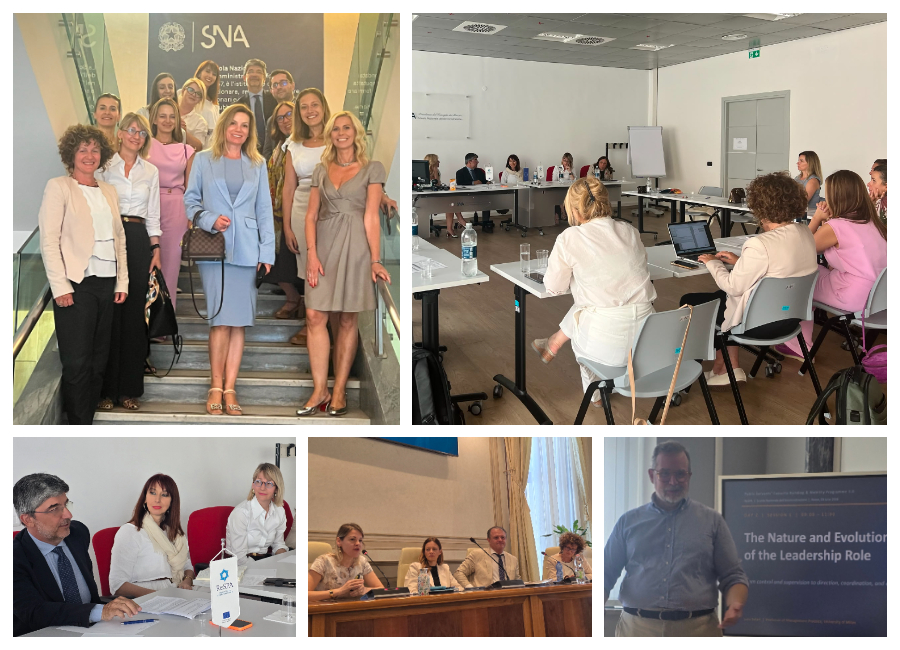
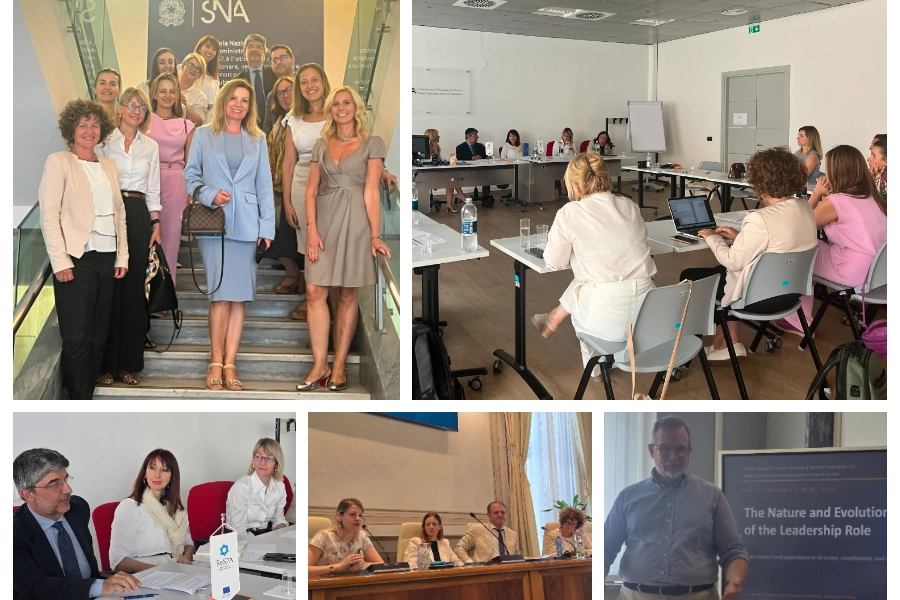
The first day of the programme includes a visit to Palazzo Vidoni, followed by a session on leadership in contemporary public administration, led by Barbara Quacquarelli, Associate Professor of Business Organization at Milano Bicocca University and Coordinator for the Human Resources Development and Innovation Division at SNA. The session set the scene by exploring leadership in complex public organisations, the transition from formal authority to organisational leadership, and the need to balance institutions, people, legitimacy and performance.
A comparative panel brought together senior public leaders from Italy and the Western Balkans in dialogue, creating space for peer exchange and reflection on leadership challenges, administrative cultures, and reform experiences. This format enables participants to compare perspectives, identify common challenges and discuss how leadership can support institutional resilience, public trust and better reform delivery.
The second day was led by Luca Solari, Professor of Management Practice at the University of Milan, and focused on the nature and evolution of the management role in contemporary public administration. Participants discussed how management is shifting from control and supervision towards direction, coordination and the creation of enabling conditions for teams and institutions to perform effectively.
The programme also addresses expectations, context and the need for continuous leadership development. Participants explore explicit and implicit expectations from superiors, peers, staff, institutions and stakeholders, as well as the relationship between short-term performance and long-term leadership quality. Discussion encourages senior managers to look beyond immediate goals and reflect on their broader organisational impact.
The final session focuses on managing one’s role through self-awareness, organisational politics and emerging themes. Topics includes how managers allocate attention, time, visibility, accessibility and control; how they navigate power, influence, legitimacy, coalitions and resistance; and how new expectations, uncertainty, overload, hybrid work, reputation and AI-related transformations are reshaping the practice of public management.
Through this module, ReSPA and its Italian partners continue to invest in leadership as a key driver of public administration reform. By combining Italian expertise, peer learning and regionally-owned solutions, the programme supports senior public managers in strengthening their capacity to lead institutions through change, manage complexity and contribute to more effective, citizen-oriented and European-ready administrations.
The Leadership Development module confirms that modern public administration requires leaders who are not only technically competent, but also reflective, adaptive and capable of building trust, guiding people and sustaining reform in increasingly complex environments.