

PA Awards 2026 - Evaluation
Submission Deadline Extended Until 15 July!
Evaluation Criteria
- Effective, Impactful & Tangible Results
- Participatory, Inclusive & Collaborative
- Transparency, Integrity & Accountability
- Sustainability
- Forward-looking & Innovative
- Visibility & Public Concern
- Transferability & Replicability
Criteria description and definitions
| CRITERIA 1 - Effective & Impactful & Tangible Results | |
|
Evidence of the transformations and improvements observed during the initiative's implementation in addressing the identified issues and challenges, as well as of the initiative's objectives, is provided. The project/case has been in operation long enough for evidence of its impacts to be available. |
Relevance: The initiative should have made a positive impact on a group(s) of the population and/or addressed a significant issue of public concern within the context of a given country or region. The evidence should demonstrate that the initiative was effective, efficient (if applicable), and had an economic impact. The inclusion of both qualitative data (increase in satisfaction) and quantitative statistics to support the initiative is encouraged. The initiative must bring a real benefit for a significant number of citizens and businesses and/or have achieved a significant reduction in direct or indirect economic costs or social savings. |
| CRITERIA 2 - Participatory & Inclusiveness & Collaborative | |
|
The initiative adopted inclusive approaches that recognise diverse needs, preferences, and challenges faced by citizens, e.g., through the involvement of beneficiaries and other stakeholders in the design, operation, management, monitoring, and evaluation of the initiative. |
The initiative should identify and map beneficiaries and other stakeholders. The initiative should demonstrate citizen engagement. The initiative should involve informing beneficiaries and stakeholders, enabling users to contribute ideas, co-design solutions, and collaborate in implementing projects, thereby fostering a sense of ownership and shared responsibility. The initiative should take into account the needs of disadvantaged, marginalised, and vulnerable populations to ensure no one is left behind. The initiative should incorporate gender mainstreaming. The initiative should build and promote partnership & collaboration. |
| CRITERIA 3 - Transparency & Integrity & Accountability | |
|
The initiative should promote openness and accountability in its processes and/or service delivery. Mechanisms such as citizen feedback channels and public consultation modes should be available. |
The initiative should provide accessible information on policies, budgets, and/or performance metrics, demonstrating that quality, ethical, and moral principles and values are integral to institutional behaviour. |
| CRITERIA 4 - Sustainability | |
|
The initiative should include elements that extend beyond the project implementation or delivery period (i.e., after the planned and realised objectives and activities). The initiative should include at least one pitch for new elements in the pipeline, to be advanced further in case the project is being rewarded. |
The changes generated by the initiative must be shown to be sustainable and unlikely to be reversed by future events, and to include measures aimed at tackling and reducing risk management. |
| CRITERIA 5 - Forward-looking & Innovative | |
|
The initiative should introduce new, future-oriented ways of working or delivering services in the public sector. The initiative must show the courage to break new ground to find innovative solutions to meet the changing needs, issues and challenges of citizens in today’s environment. The initiative should demonstrate putting new ideas into practice and, if applicable, harnessing emerging technologies and innovation as powerful enablers. The initiative, having the potential to become a flagship example in the field, is an asset. |
The initiative should present new ideas and follow a future-oriented approach. The initiative should use up-to-date tools and contemporary solutions. The initiative should be inventive in its strategy, processes, service design/delivery, and/or systems, considering future eventualities, scenarios, and outcomes. The initiative should demonstrate a leap in creativity and innovation in the practice of public administration that goes beyond current practices. |
| CRITERIA 6 - Visibility & Public Concern | |
|
Users should benefit from the initiative's added value and see its advantages; hence, it must be visible and distinctive (at least within the users' community). The issues that are tackled in the project should be of interest or importance to the community or the wider public. |
The initiative should address a pressing need or solve a concern/issue (narrow or wider) in the community and thus have the potential for visibility. It reflects the collective interests, values and priorities of the target group/users in question. |
| CRITERIA 7 - Transferability & Replicability | |
|
The initiative should be replicable across different settings and contexts in the Western Balkans and beyond. The application should include an explanation and demonstration of the key factors that ensured the initiative's success, and any lessons learnt from this process that can be transferred. |
The initiative should be able to be disseminated as a best practice at the state and regional levels. The initiative should have the potential for universal appeal, replication and transfer. The initiative should be adaptable to solve problems in similar organisations and extraordinary situations. Documentation and building on (developing) the initiative. The initiative should have identifiable ‘learning points’ with key examples for improvement in other places and fields. |
Four-step Evaluation & Selection Process after eligibility check
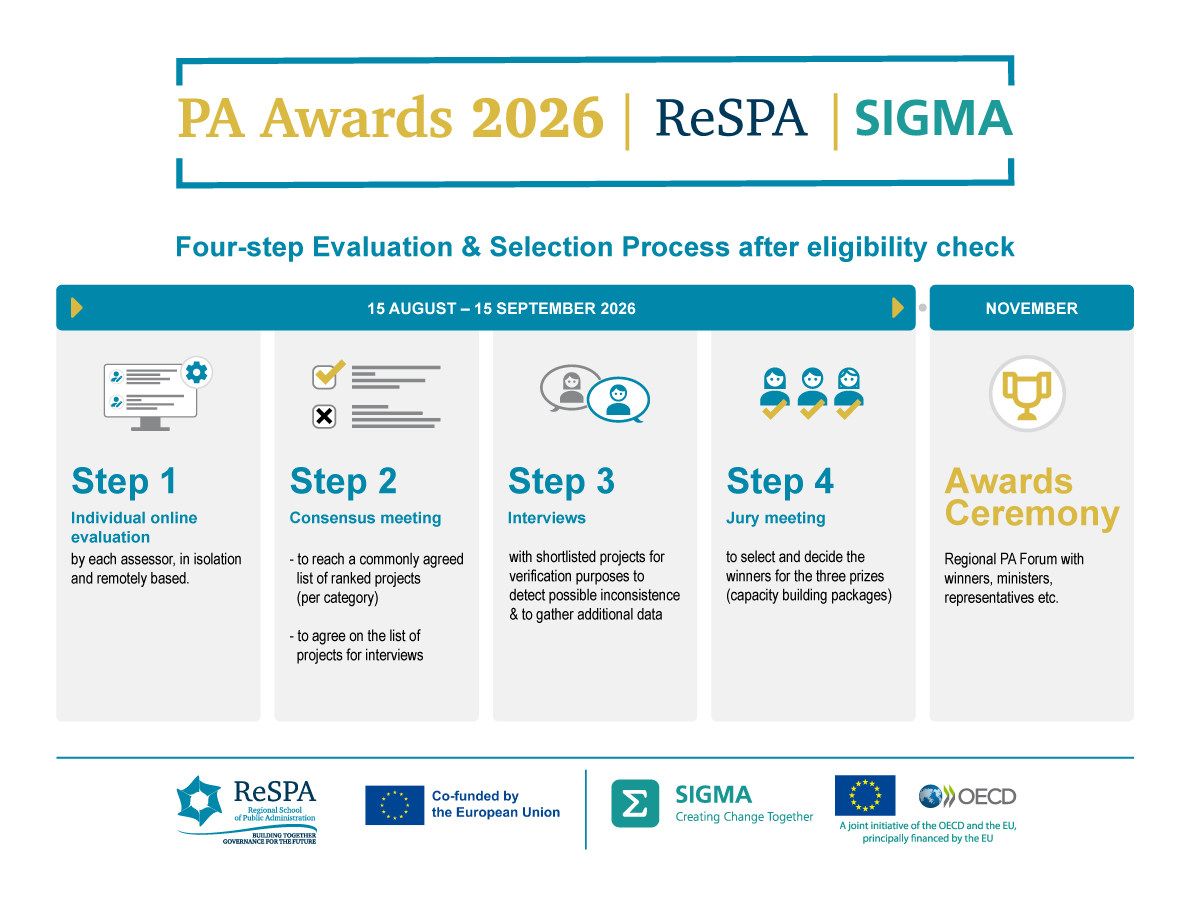
The International Jury is composed of ReSPA representatives and/or ReSPA-selected independent experts and SIGMA representatives and/or experts appointed by them.
If you have any questions related to the rules of the contest, eligibility and other requirements or have any difficulties with the online registration and application tool, please contact: pa-awards@respaweb.eu