

From Policy Priorities to Competitive EU Projects: ReSPA Supported Montenegro’s Institutions in Accessing LIFE Funding
31 August – 1 September 2026, Podgorica
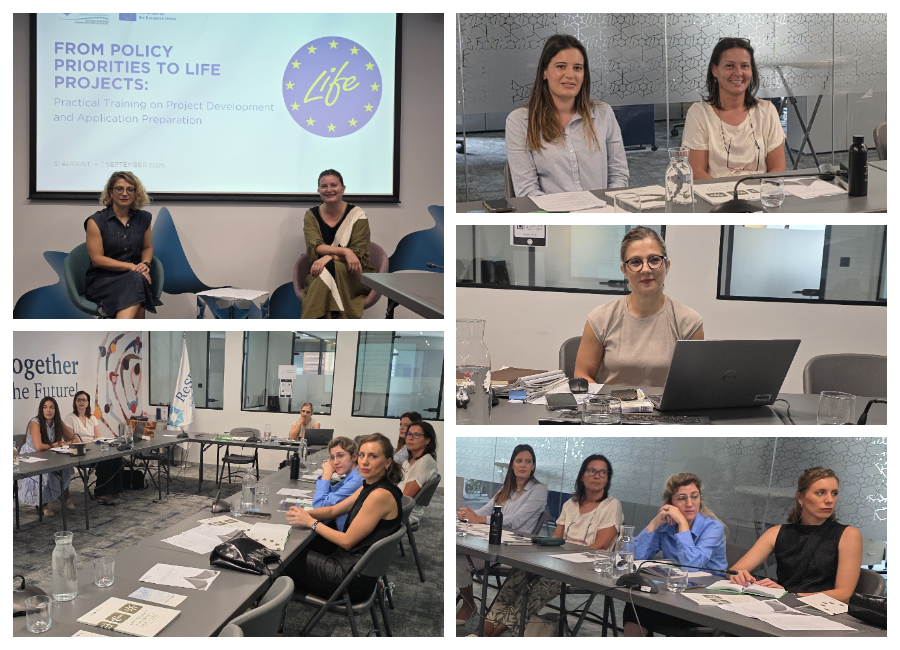
ReSPA hosted the two-day practical training programme “From Policy Priorities to LIFE Projects: Practical Training on Project Development and Application Preparation,” bringing together representatives of Montenegro’s Ministry of Energy and Mining and other relevant institutions, to strengthen their capacities to translate national energy and climate priorities into high-quality and competitive project proposals under the European Union’s LIFE Programme.
The training represented the first of two specialised capacity-building activities delivered through ReSPA’s On-Demand Support mechanism, following a request submitted by the Ministry of Energy and Mining of Montenegro. Through this tailored support, ReSPA helped the Ministry and participating institutions strengthen the practical knowledge and skills required to identify relevant EU funding opportunities, develop solid project concepts, establish effective partnerships and prepare applications in line with European evaluation standards.
The programme was opened by Jelisaveta Tasev, ReSPA Programme Manager, who welcomed the participants and highlighted the importance of strengthening the capacities of Montenegrin institutions to access and effectively use EU funding opportunities: “Becoming better acquainted with the LIFE Programme is particularly important for Montenegro’s institutions, as it enables them to connect national energy, environmental and climate priorities with concrete EU funding opportunities. Through this practical training, we wanted not only to introduce participants to the programme and its requirements, but also to help them transform their expertise and policy priorities into well-structured and competitive project proposals. By strengthening these capacities, we are supporting institutions in becoming more proactive and successful participants in European programmes and in developing projects that can contribute directly to Montenegro’s green and energy transition.”
The programme was led by Nikolina Petković Gregorić, an experienced LIFE Programme expert and Croatia’s National Contact Point for LIFE at the Ministry of Environmental Protection and Green Transition. Drawing on her extensive experience in supporting applicants and implementing activities related to the LIFE Programme, she guided participants through the programme’s structure, priorities, funding rules, application requirements and evaluation criteria.
The training was held at an important moment for Montenegro’s energy and climate agenda. The LIFE Programme is the European Union’s flagship funding instrument for the environment, climate action and the clean energy transition. It supports projects that contribute to the implementation of EU policies and legislation in areas including climate change mitigation and adaptation, energy efficiency, renewable energy, decarbonisation, environmental protection and the transition towards a sustainable and climate-neutral economy.
For Montenegro’s institutions, the training provided an opportunity to connect domestic policy priorities with concrete European funding possibilities. While participating institutions already possessed considerable policy and technical expertise, successful participation in competitive EU programmes also required specialised project-development skills - from interpreting calls for proposals and defining a convincing intervention logic to structuring work packages, preparing realistic budgets and demonstrating measurable European added value.
For this reason, the programme was designed as an intensive and interactive workshop rather than a conventional presentation-based training. Participants worked on real project ideas proposed by their institutions and gradually developed them into more structured project concepts. This hands-on approach enabled them to immediately apply the knowledge acquired during the sessions and receive expert guidance on the strengths, weaknesses and development potential of their proposals.
During the first day, participants were introduced to the structure, objectives and funding opportunities of the LIFE Programme. The sessions explained how to analyse LIFE calls and supporting documentation, understand the requirements of different sub-programmes and assess whether an institutional project idea was suitable for LIFE funding.
Particular attention was devoted to areas closely connected with the mandate of the Ministry and Montenegro’s reform priorities, including Climate Change Mitigation and Adaptation, Climate Governance and Information, and Clean Energy Transition. Participants explored how projects addressing energy efficiency, renewable energy, decarbonisation, climate policy and the Just Transition could be positioned within the LIFE framework.
The first day also introduced participants to the fundamentals of project development logic. They learned how to move from a broadly defined policy challenge to a clearly structured project proposal by identifying the problem to be addressed, target groups, project objectives, proposed activities, expected results and long-term impact.
A dedicated session on evaluation criteria helped participants understand how LIFE proposals were assessed and which elements distinguished a relevant project idea from a convincing and competitive application. This provided an important basis for examining project ideas from an evaluator's perspective and identifying areas requiring further development.
The second day focused on transforming the acquired knowledge into concrete project components. Through a practical project-development exercise, participants further elaborated their ideas and considered how they corresponded to the priorities of the Clean Energy Transition sub-programme.
They worked on preparing application forms and designing coherent work packages, including defining activities, responsibilities, outputs, milestones, and implementation arrangements. The programme also covered eligible costs and budget planning, helping participants understand how to prepare a realistic budget that was fully aligned with the proposed activities and compliant with LIFE funding rules.
The final part of the training was dedicated to practical tips, lessons learned from LIFE project preparation and implementation, and an open question-and-answer session. This exchange gave participants an opportunity to discuss specific challenges faced by their institutions and receive targeted expert advice on how to further develop their project ideas following the workshop.
By the end of the training, participants had gained a clearer understanding of LIFE priorities, application requirements, funding rules and evaluation criteria. More importantly, they had strengthened their practical capacity to identify suitable calls, formulate credible project interventions and prepare stronger EU funding applications.
The training helped establish a stronger institutional basis for developing concrete LIFE project proposals and supported participating institutions in identifying the next steps to further elaborate their project ideas.
The second training within the same On-Demand Support project will focus on the Horizon Europe Programme and will take place on 10–11 September 2026, also at ReSPA’s premises in Podgorica. Together, the two training programmes are designed to provide participants with a broader understanding of the EU funding landscape and help them identify the most appropriate programme and calls for their institutional, policy and investment priorities.
Through this On-Demand Support project, ReSPA continued to respond directly to the priorities expressed by its Members and provide practical, needs-based assistance with tangible institutional value. By combining the LIFE and Horizon Europe training programmes, ReSPA and the Ministry of Energy and Mining of Montenegro established a comprehensive capacity-building pathway - from understanding EU funding instruments and identifying suitable opportunities to developing partnerships and transforming national policy priorities into feasible, well-structured and competitive European projects.