

NextGenGov Launched to Build a New Generation of Digital Leaders in Montenegro’s Public Administration
Podgorica, Montenegro
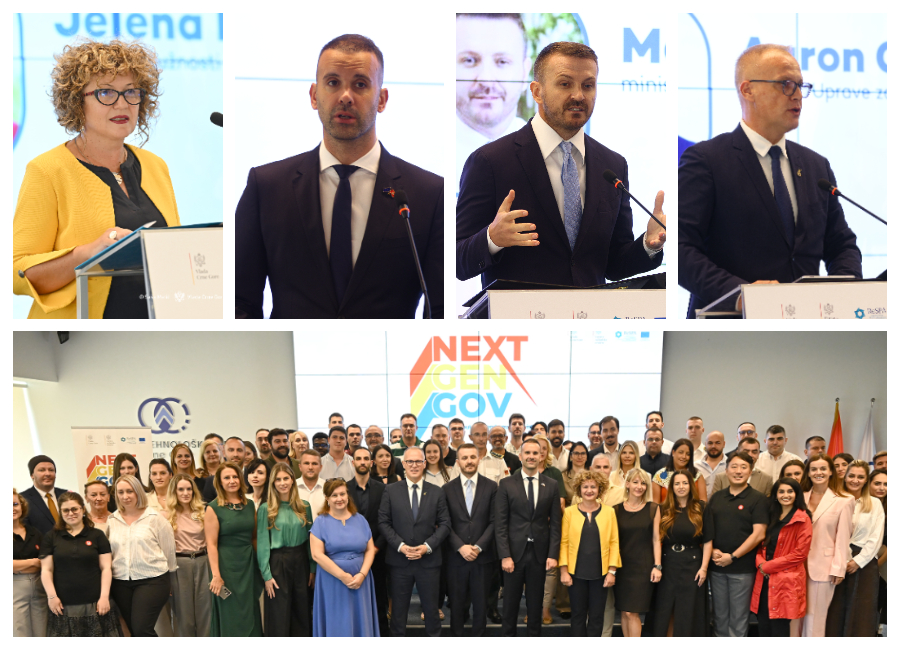
The ReSPA, in partnership with Montenegro’s Human Resources Management Authority (HRMA) and with the support of the Government of Montenegro, launched the NextGenGov – Training Programme for Modern Administration at the Science and Technology Park of Montenegro.
Over the next three months, ReSPA and HRMA will implement this intensive, practice-oriented programme to strengthen the advanced digital competencies of Montenegro’s public servants. By combining international expertise with the concrete needs of national institutions, the programme will equip participants to use data more effectively, develop digital solutions, apply artificial intelligence responsibly and design public services around the needs of citizens and businesses.
The programme represents an important investment in the people who will lead Montenegro’s digital transformation and translate technological progress into faster, more efficient and accessible public services.
“Fully aware of the scope of this programme and the fact that, for the first time, we are engaging so intensively with technologies that are transforming the world before our eyes every day, I am confident that Next Gen Gov represents a genuine small-scale revolution in our system—one that will change the way we view investment in people, as well as the direction of their further education and professional development,” said Prime Minister Milojko Spajić.
The Prime Minister emphasised that, precisely because of its design, the programme forms part of Montenegro’s response to the challenges posed by rapidly advancing technologies, as well as those related to human resource capacity and the quality of public services.
“Let today mark only the beginning of our collective administrative transformation—a testament that the time has come for people who lead through knowledge and by example,” the Prime Minister concluded.
Marash Dukaj, Minister of Public Administration, stressed that “public administration reform depends on people,” addressing the participants with the following message: “Technology is only our instrument; people are the drivers of transformation. You are bringing new energy, new skills and a new vision of workplace culture into our system. You are the drivers of change who are building a modern Montenegro.”
Agron Camaj, Director of the Human Resources Management Authority, emphasised: “We do not wait for the future – we build it through knowledge. Through this modern training programme, we want to empower new generations of public servants – generations that will not fear change, but will recognise it as an opportunity for the development and progress of our Montenegro.”
Jelena Mrdak, Acting Director of ReSPA, stressed that the true value of the programme will be measured by its tangible impact within institutions and for citizens: “We want participants to return to their institutions not only with a certificate, but with a concrete solution – a simpler procedure, an automated report, a prototype of a digital service, or a clear idea of how to use artificial intelligence responsibly. The ultimate result should be visible to citizens – through fewer steps, clearer information and better-quality public services.”
Over 60 working days of intensive, practical and project-based learning, participants will address real-life challenges faced by public administration. The aim is to empower them not merely as users of new technologies, but as drivers of institutional change who can improve internal processes, develop digital services and transfer knowledge across their organisations.
The programme consists of four specialised learning tracks:
- Data Analytics – using data, preparing reports and developing interactive dashboards to support evidence-based decision-making;
- Data Science – applying Python, machine learning and generative artificial intelligence to public-sector challenges;
- Software Engineering – developing modern web applications, digital services and solutions for automating administrative processes;
- User Experience Design (UX) – creating simpler, more accessible and user-friendly digital services for citizens, businesses and public servants.
The Data Analytics and Data Science modules will begin on 7 September 2026, while the Software Engineering and User Experience Design modules will start on 21 September 2026. Applications for the latter two modules will remain open until the training begins or until all available places have been filled.
The training will be delivered at the Science and Technology Park of Montenegro by General Assembly, an international education organisation that has developed contemporary digital and ICT skills since 2011 and brings together a global alumni network of more than 110,000 professionals. The programme will be conducted in English with the support of international trainers and experts.
By implementing NextGenGov together with HRMA and with the support of the Government of Montenegro, ReSPA is helping establish a sustainable network of public-sector professionals capable of initiating digital reforms, responsibly using emerging technologies and continuously improving the quality of public services. The programme will also contribute to a broader institutional culture of innovation, knowledge-sharing and citizen-centred governance across Montenegro’s public administration.