

From Rules to Results: ReSPA, SIGMA and CEF Advance Smart Controls for Stronger Governance
8–10 September 2026, Ljubljana, Slovenia
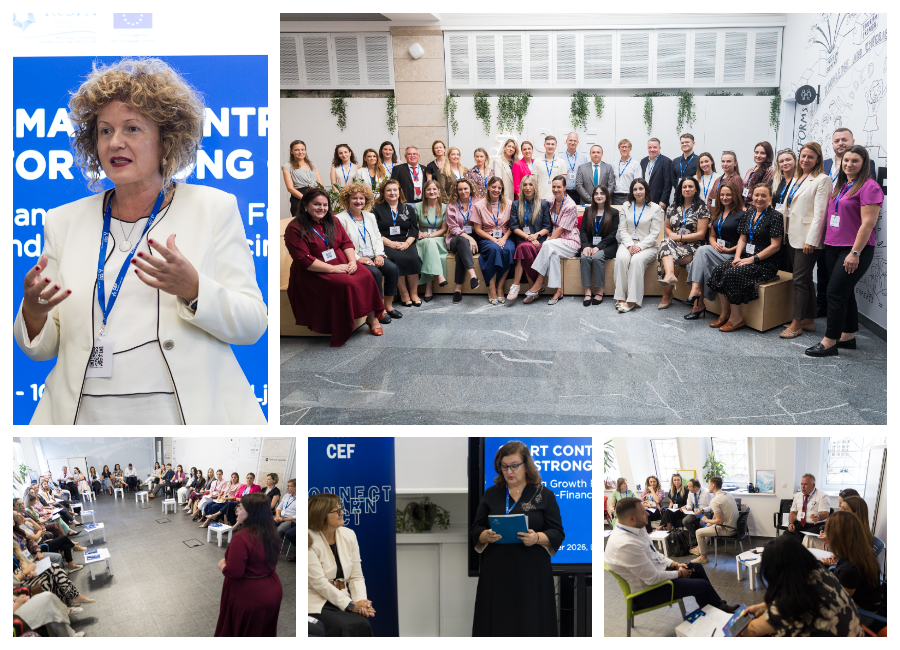
ReSPA, the SIGMA Programme and the Center of Excellence in Finance (CEF) concluded a three-day regional workshop in Ljubljana dedicated to one of the most important implementation challenges facing public administrations today: ensuring performance-based financing delivers credible reforms, protects public resources and produces measurable results for citizens.
The workshop, ‘Smart Controls for Strong Governance: Managing Growth Funds, Indicators and Double-Financing Risks’, brought together 16 speakers and experts, alongside public administration practitioners from across the region. It focused on the governance, monitoring, control and audit arrangements required for the effective implementation of the EU Reform and Growth Facility and other performance-based financing instruments.
The Ljubljana workshop also marked a continuation of the strong cooperation between ReSPA, SIGMA and CEF. Building on the Regional Conference on Public Financial Management reforms organised by the same partners in Montenegro in September 2025, the programme moved the discussion from shared priorities and standards towards practical solutions for implementation.
Opening the workshop, Jana Repanšek, Director of CEF; Jelena Mrdak, ReSPA Director ad interim; and Klas Klaas, Senior Expert at SIGMA, underlined the importance of strong partnerships and complementary expertise in supporting administrations through increasingly demanding reform and financing frameworks. Rozalija Karchicka-Vasilevska, ReSPA Programme Manager for Public Financial Management, coordinated the programme and guided the reflections throughout the three days.
“Public Administration Reform cannot succeed without sound Public Financial Management. Policies need budgets. Reforms need resources. Resources need effective controls. And ultimately, institutions need to turn public money into tangible results for citizens. Smart controls should not slow reforms down – they should make reforms safer, more credible and more sustainable,” said Jelena Mrdak, ReSPA Director ad interim.
The first day established the governance foundations for managing reform measures and performance-based funding. Klas Klaas and Robertina Gjoka Vasilieva of CEF opened the technical programme with a discussion on governance arrangements and a practical comparison between the Reform and Growth Facility and IPA-funded assistance. Representatives of Central Harmonisation Units and finance ministries from Montenegro, North Macedonia, Bosnia and Herzegovina and Croatia then examined the respective roles of reform coordinators, internal control and internal audit. Mirjam Novaković of Slovenia’s Budget Supervision Office added an EU Member State perspective through lessons from the Recovery and Resilience Facility, followed by a World Café on the implications of the Reform and Growth Facility for Public Internal Financial Control.
Day two turned to assurance, evidence and audit. Maksim Acevski of the State Audit Office of North Macedonia and Aljanka Klajnšek of the Court of Audit of the Republic of Slovenia discussed the role of external audit in performance-based financing. Klas Klaas explored the reliability of data and indicators, while Joyce Teunissen and Robertina Gjoka Vasilieva of CEF led practical work on risk-based internal audit planning. Together with Alastair Swarbrick of SIGMA, participants identified opportunities for stronger internal and external audit, before Iain Murray of CIPFA and Alastair Swarbrick addressed management declarations, internal control self-assessment and continuous monitoring.
The final day focused on protecting public resources. Joyce Teunissen and Robertina Gjoka Vasilieva examined PIFC fundamentals and their role in preventing and detecting irregularities and fraud. Katharina Herrmann of the European Anti-Fraud Office (OLAF), joining online, presented systems for reporting and managing irregularities and fraud in EU accession countries. Participants also worked through double-financing risks from an internal audit perspective and considered, with Alastair Swarbrick, how internal audit can contribute already at the reform design stage.
Designed as a practical regional exchange rather than a traditional training, the workshop combined expert input, country experience, group assignments and peer learning. Participants were encouraged to bring real cases and difficult questions into the room, compare how different administrations are responding to similar challenges, and identify concrete ideas that can be applied in their own institutions.
The Ljubljana workshop is part of ReSPA’s broader effort to strengthen its engagement in Public Financial Management, responding directly to the priorities of its members and to the demands of the EU integration process. Its value will ultimately be measured not by the number of presentations delivered, but by what changes afterwards: the ideas participants take back to their institutions, the professional connections they continue to use, and the improvements they are able to put into practice.
“ReSPA's goal for the Ljubljana workshop is for participants to leave with practical, usable outputs — a clearer risk map, defined responsibilities, a stronger audit approach, a concrete control idea, and a regional colleague to call on similar problems. This reflects ReSPA's core value: connecting institutions and practitioners across the region to turn shared knowledge into real implementation,” said Rozalija Karchicka Vasilevska, ReSPA Programme Manager.
By connecting rules with implementation, controls with results and regional experience with practical solutions, ReSPA, SIGMA and CEF are helping administrations build the systems and capacities needed to manage public resources with greater accountability, credibility and trust – and to turn performance-based funding into reforms that citizens can see and feel.