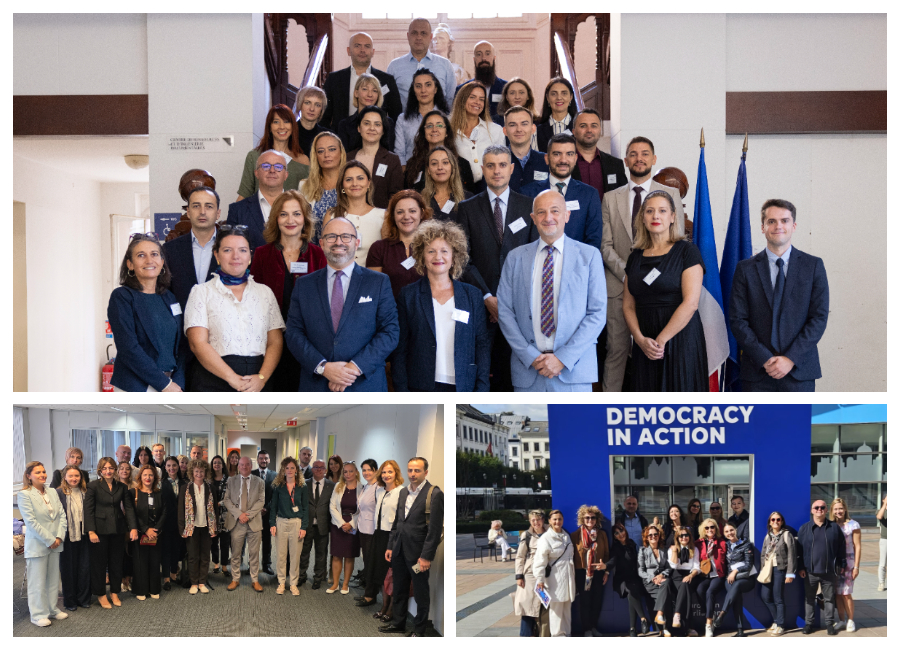


ReSPA Leadership Academy Connected Senior Reform Leaders with French and EU Institutions
How can senior public officials lead complex reforms, mobilise institutions around a shared vision and navigate the challenges of EU integration in an environment marked by rapid technological change and growing public expectations?
ReSPA is responding to these challenges by launching the first module of its flagship Leadership Academy, an ambitious executive development programme that brings together high-ranking public officials from the Western Balkans, Ukraine, Moldova and Armenia for an innovative learning journey across Paris and Brussels.
Held from 14 to 18 September 2026, the Module 1: “Leadership – Embodying, Inspiring and Mobilising” combined an intensive executive leadership programme at the French Institut national du service public (INSP) with institutional exchanges in Brussels and an innovative Leadership Enlargement Walk, organised in cooperation with the European School of Administration (EuSA).
The programme was officially opened by Jelena Mrdak, ReSPA Director a.i., who welcomed the participants and presented the vision behind the Academy’s three-year regional leadership development journey.
“Leadership today is not only about managing institutions—it is about inspiring people, building trust and mobilising collective action around reforms that bring tangible benefits to citizens. Through the ReSPA Leadership Academy, we are introducing an innovative, experiential approach that combines personal development, peer learning and direct exposure to leading French and EU institutions. By bringing together senior officials from the Western Balkans, Armenia, Moldova and Ukraine, we are investing in a strong community of reform leaders who can drive institutional transformation and bring their administrations closer to the European Administrative Space,” said Mrdak.
Senior public managers from the Western Balkans, Armenia, Moldova and Ukraine held leadership responsibilities and played direct roles in public administration reform, public financial management and EU accession. Their seniority and institutional responsibilities were central to the programme’s wider impact. Beyond strengthening individual leadership skills, the Academy equipped participants to apply and share their knowledge within their institutions, lead complex reform processes and contribute to lasting administrative transformation.
The Paris component, hosted by INSP from 14 to 16 September, moved beyond conventional classroom-based training by combining leadership assessments, practical exercises, role-play, peer feedback and facilitated reflection.
Participants explored their leadership profiles, behavioural preferences and executive posture, while examining the difference between leadership and management. They worked on developing team autonomy, adapting leadership styles to different professional situations and strengthening both verbal and non-verbal communication.
The programme then focused on building and communicating an ambitious yet credible institutional vision. Through practical exercises, stakeholder mapping and the “strategy of allies,” participants explored how to mobilise colleagues, build coalitions and generate support for institutional change. They also practised handling difficult conversations, expressing disagreement constructively and responding to obstructive behaviour.
The final Paris session addressed leadership, change and innovation in the age of artificial intelligence. Participants considered how AI was reshaping the role of public-sector leaders while highlighting the continued importance of distinctly human qualities such as judgement, empathy, curiosity, trust and ethical responsibility.
Through a leadership lab and the practical application of the TATIN methodology, they examined the relationship between mindset and method and explored how active listening could strengthen trust and foster innovation within public institutions.
The Paris component of the Module 1 of the Academy was implemented within the framework of BRIDGE to EU – France for Good Governance in the Western Balkans, a two-year programme funded by the French Ministry for Europe and Foreign Affairs and implemented in close cooperation with ReSPA. The module demonstrated the strong and steadily expanding relationship between ReSPA and French institutions. This cooperation has grown significantly since the signing of the Declaration of Intent with the French ministry responsible for public administration in November 2023.
Following the intensive programme in Paris, participants continued their learning journey in Brussels, where leadership development was directly connected to the European Union's institutional and administrative environment.
During a tailored visit to the European Commission Visitors’ Centre, participants deepened their understanding of how EU institutions function, the Commission’s role, enlargement policy, and the importance of public administration reform and good governance in the accession process.
The visit provided senior officials responsible for EU-related reforms with closer insight into the European Union's administrative culture, values, and decision-making practices.
Participants also exchanged experiences with the Belgian Federal Public Service Policy and Support (BOSA). Discussions focused on Belgian public administration practices, leadership and learning development, innovation, institutional collaboration and support for public-sector reform.
These exchanges strengthened the direct connection between regional public administrations and institutions operating within the European Administrative Space, enabling participants to complement their knowledge of EU requirements with a better understanding of European professional practices and institutional culture.
The programme concluded with the Leadership Enlargement Walk, organised in cooperation with the European School of Administration. - This innovative format took leadership learning beyond the traditional training environment, creating space for movement, dialogue, peer exchange, and reflection on the role of senior public officials amid renewed EU enlargement momentum.
The Walk connected two central dimensions of the Academy: the individual leadership journey of each participant and the broader European journey of their administrations. Cooperation with EuSA also provided insight into how leadership capacities and shared administrative values are developed within EU institutions.
The ReSPA Leadership Academy was designed as a three-year, cohort-based learning journey rather than a one-off training activity. Its long-term format will enable participants to apply new approaches in their institutions, reflect on their experiences and continue developing alongside a trusted regional network of peers.
Following the Paris and Brussels programme, the Academy’s second module will take place in Strasbourg and focus on decision-making and communication in crisis situations through practical exercises and an immersive simulation. The third module will address leadership culture.
Through the Leadership Academy, ReSPA has invested simultaneously in people, institutions and professional networks. By connecting senior reform leaders from nine administrations with French and EU institutions, the programme has laid the foundation for more strategic, collaborative and innovative public-sector leadership - capable of transforming reform ambitions into sustainable results for citizens and bringing regional administrations closer to their shared European future.