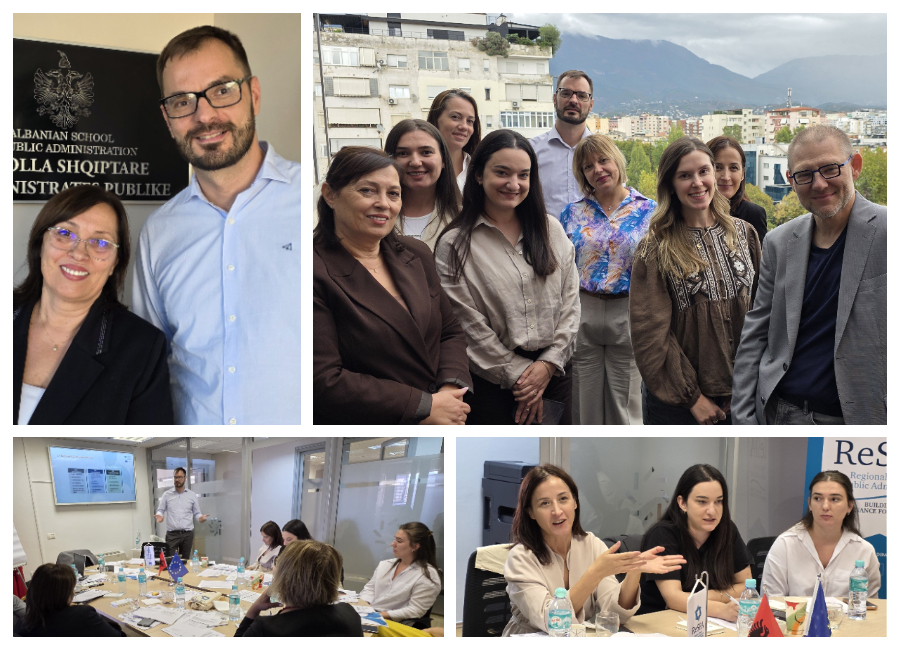


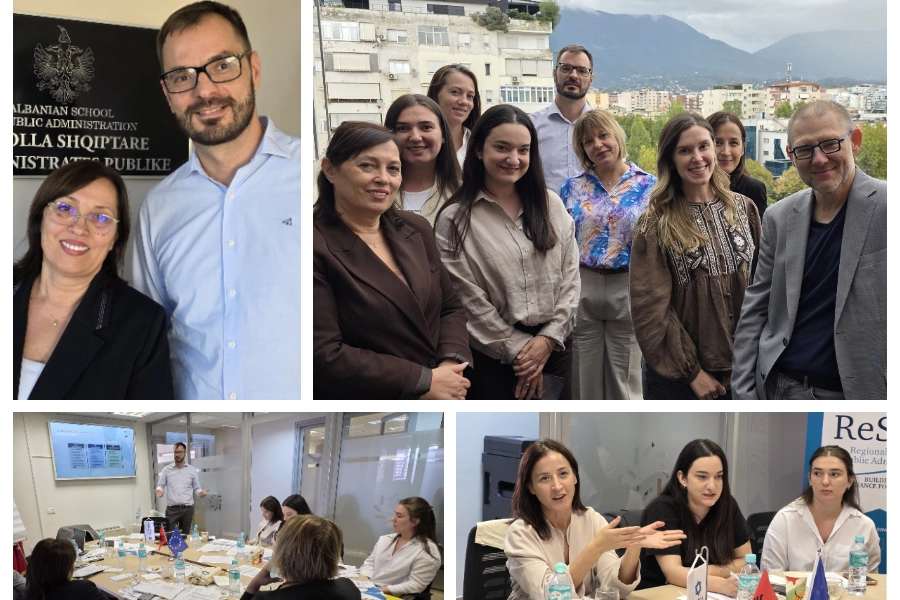
ASPA Begins Its CAF Journey towards Becoming Albania’s National Resource Centre
24–25 September 2026, Tirana, Albania
The Albanian School of Public Administration (ASPA), with the support of ReSPA’s Regional Quality Management Centre, has begun implementing the Common Assessment Framework (CAF), taking an important first step towards stronger institutional performance and its future role as Albania’s National CAF Resource Centre.
The process carries a dual ambition: to help ASPA systematically assess and improve its own organisation, while developing the practical experience, knowledge and institutional capacity needed to support other public institutions in Albania on their quality management journeys.
This first training, held on 24 - 25 September, marks the beginning of a broader process that will continue over several months through training, hands-on mentoring, self-assessment, consensus building and improvement planning.
ASPA’s CAF Self-Assessment Group is at the centre of the process. Guided by ReSPA and KDZ Austria, participants are learning how to assess an organisation through the nine CAF criteria, examine evidence, recognise institutional strengths and identify areas where improvement is needed.
Working individually and in groups, participants are exploring ASPA’s key stakeholders and service users, assessing both organisational enablers and achieved results, and applying the Plan-Do-Check-Act cycle to CAF scoring. They are also identifying potential improvement actions and discussing how the findings can be translated into a realistic and prioritised Improvement Action Plan.
The programme goes beyond learning about CAF in theory. By experiencing every stage of implementation within their own organisation, ASPA staff will gain first-hand insight into the practical challenges, success factors and support needs that other public institutions encounter when introducing CAF.
Elda Baguca, Head of Development Unit, ASPA and CAF Programme Manager, underlined: “For ASPA, CAF is both an institutional improvement process and a long-term investment in Albania’s public administration. It will help us look honestly and systematically at how we work, turn evidence into concrete improvements, and prepare ASPA to become a trusted national source of CAF knowledge and support for other institutions”
Leadership plays a critical role in setting the direction, ensuring institutional commitment and creating the conditions for improvement. At the same time, the ownership of ASPA’s Self-Assessment Group will be decisive in translating this commitment into evidence-based actions and embedding continuous improvement into the institution’s everyday work.
“This is precisely the kind of change ReSPA’s Regional Quality Management Centre was created to support: an institution improves its own performance and, at the same time, develops the capacity to help others do the same. By supporting ASPA’s CAF journey and its preparation to become Albania’s national CAF resource, we are investing in knowledge that remains in the administration, travels between institutions and strengthens public services across the region,” said Slaven Bukarica, ReSPA Programme Officer for Quality Management.
The second part of the programme focuses on ASPA’s ambition to become Albania’s National CAF Resource Centre - A National CAF Resource Centre serves as a central source of expertise, guidance and practical support for public institutions applying CAF. Its role includes promoting the model, supporting CAF users, strengthening national practitioner networks and helping institutions sustain their improvement efforts.
To support ASPA in preparing for this role, Thomas Prorok, Managing Director of KDZ, shared practical lessons from the Austrian CAF Centre, one of the longest-established national CAF centres in Europe. This experience provides valuable insights into how CAF can be promoted, supported and sustainably embedded across a national public administration.
ReSPA is complementing this perspective by presenting the services and regional support available through its Regional Quality Management Centre and facilitating discussions on the potential responsibilities, services and next steps for ASPA as a future National CAF Resource Centre.
The process will help ASPA develop not only its internal quality management capacity but also the foundations for supporting a wider national CAF community. Its expected results include a validated Self-Assessment Report, a prioritised Improvement Action Plan, strengthened facilitation capacities among ASPA staff and practical guidance for the future organisation and operation of the Resource Centre.