


From Reform Commitments to Results: ReSPA at Tirana Connectivity Forum 2026
As the EU enlargement process shifts from preparation to delivery, Western Balkan administrations face a more concrete question: are institutions ready not only to plan reforms, but to show they are producing results?
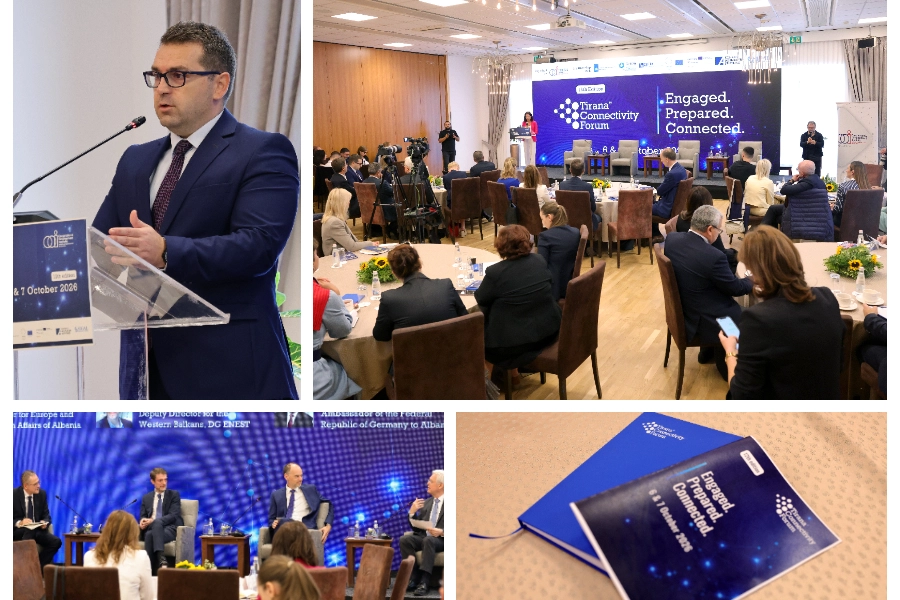
This was at the heart of the Tirana Connectivity Forum 2026, held on 6–7 October in Tirana, where ReSPA joined policymakers, EU representatives, public administration leaders and regional stakeholders to discuss the institutional capacities needed for the next phase of EU integration.
The Forum took place at a key moment in the enlargement process. With accession negotiations advancing, new EU financial instruments being implemented across the Western Balkans and preparations for the next EU Multiannual Financial Framework already underway, attention is increasingly turning towards institutional readiness, measurable results and effective implementation of national reform agendas.
Representing ReSPA, Filip Chaparoski, Eastern Partnership Policy Officer, provided the opening framing for the session “Readiness under Scrutiny: Reform and Growth Facility and Institutional Preparedness for EU Performance-based Instruments.” The discussion examined lessons from the first implementation cycle of the Reform and Growth Facility (RGF), focusing on administrative capacity, inter-institutional coordination, accountability and the governance arrangements required to manage increasingly performance-oriented EU instruments. “Performance-based financing puts forward a different question: not what activities were completed, but what changed as a result – and whether administrations can demonstrate it in practice. Institutional readiness is not a checklist of structures, but the ability of institutions to work together, deliver results and take responsibility for them,” Chaparoski emphasised.
The session brought together Eridana Çano, General Director of Albania’s State Agency of Strategic Programming and Aid Coordination and Reform and Growth Facility National Coordinator; Bojan Vujović, National Reform Agenda Coordinator at the Ministry of European Affairs of Montenegro; and Laima Liucija Andrikienė, Member of the European Court of Auditors. The discussion was moderated by Krisela Hackaj, Executive Director of the Cooperation and Development Institute.
As EU integration becomes more closely linked to milestones, measurable outcomes and performance-based financing, public administrations need more than formal strategies and coordination structures. They need institutions capable of working across organisational boundaries, using evidence effectively, monitoring implementation, managing risks and demonstrating that reforms are producing tangible results.
This shift places civil servants and institutional capacity at the centre of the enlargement process. It is also where ReSPA’s regional role becomes particularly relevant: connecting administrations, strengthening professional capacities, enabling peer exchange and helping public officials translate European requirements into practical solutions within their own institutions.
The broader Tirana Connectivity Forum 2026 reflected the same transition. Under the theme “Engaged. Prepared. Connected.”, the Forum explored what is required to translate enlargement commitments into concrete outcomes while preserving accountability and public ownership of reforms. Alongside institutional preparedness, discussions addressed regional trade, the Common Regional Market, transport connectivity and the integration of the Western Balkans into European networks.
For ReSPA, participation in such regional platforms is part of a wider commitment to ensuring that administrations are equipped for this new stage of integration. Through professional development, regional cooperation, peer learning and targeted support, ReSPA continues to strengthen the skills and institutional capacities of public administrations across the Western Balkans and Eastern Partnership region.
Because as the enlargement process increasingly moves from commitments to delivery, strong institutions will ultimately determine whether reforms exist only on paper – or translate into measurable improvements for citizens.