

From readiness to action: ReSPA and Croatian NSPA strengthen AI governance and digital skills in public administration across the Western Balkans and Eastern Neighbourhood
3-4 March 2026, Zagreb, Croatia
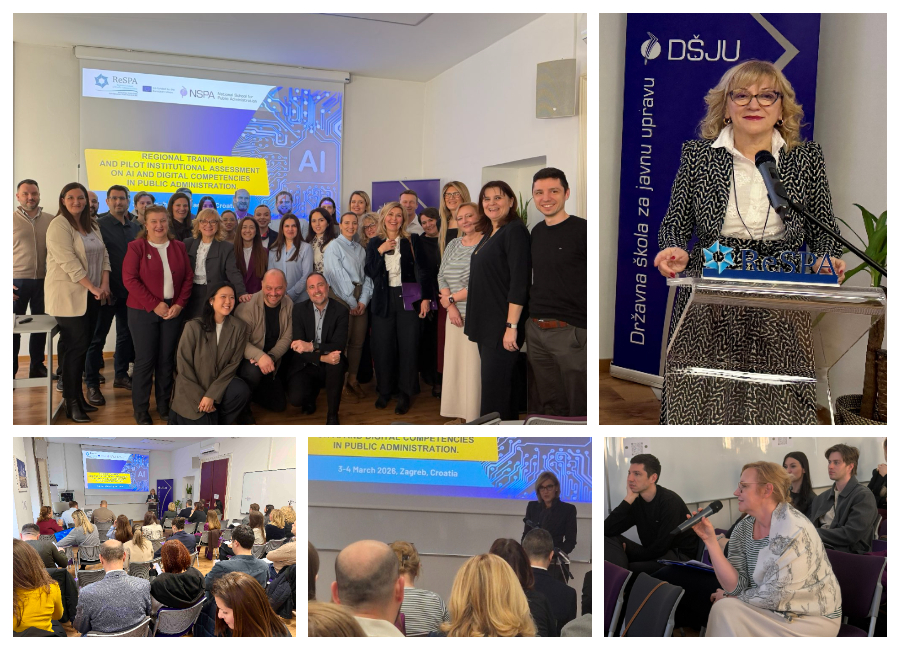
ReSPA, Croatian National School of Public Administration (NSPA), and UNESCO, hosted training on “AI and Digital Skills in Public Administration and a Pilot Assessment”, reflecting the growing demand from administrations in the Western Balkans (WB), Ukraine, Moldova and Armenia for practical, reform-oriented support in integrating artificial intelligence into public sector governance.
Opening remarks were delivered by Ms Bojana Bajić, Digitalisation and Innovation Officer at ReSPA; Mr Ivan Lakoš, Acting Director General of the Directorate for Digital Society Development and Strategic Planning at the Ministry of Justice, Public Administration and Digital Transformation; and Ms Valentina Miličić, Assistant Director of the National School for Public Administration. The speakers reflected on AI-driven public sector transformation in the Western Balkans and the Eastern Neighbourhood, emphasising the role of public servants in driving responsible AI adoption and highlighting why AI is no longer an IT topic, but a strategic leadership and governance issue that requires institutional ownership, clear accountability, and informed decision-making at all levels of public administration.
Bojana Bajić underlined the practical focus of the initiative, noting: “Our objective is to move administrations from abstract discussions on artificial intelligence to concrete, informed action. AI governance is not about technology alone - it is about people, skills, values, and institutions. Through this programme, we are supporting public administrations to realistically assess where they stand, identify priority gaps, and build the capacities needed to use AI responsibly and in the public interest.”
The training translated learning into tangible outcomes, including completing pilot AI self-assessments, identifying institutional and regional skills gaps, and drafting AI introduction and capacity-building action plans. Consolidated findings will be presented at a regional online event in November 2026, offering an evidence base to inform upcoming reform efforts and donor-funded programmes across the Western Balkans and Eastern Neighbourhood.
The first day of programme focuses on strengthening foundational knowledge and establishing a shared baseline for institutional readiness, including ReSPA experts - Mr Vedran Antoljak who elaborated on “What AI Is Today”, and Mr Matej Vuk who elaborated constrains and risks in public administration, explaining AI concepts in accessible language and addressing realistic use cases, data requirements, and risks related to privacy, bias, security, and accountability. Interactive exercises. Ms Anne-Lise Tan (UNESCO / University of Oxford) presented the UNESCO AI Competency Framework - a strategic tool for workforce planning and institutional development, clarifying the distinction between user-level AI skills, analytical capacities, and managerial and leadership competencies, as well as introducing the UNESCO AI MOOC as a complementary learning resource.
Mr Pavel Ivanov, Executive Director of the Bulgarian Institute of Public Administration (IPA), presented the AI Readiness and Institutional Self-Assessment and AI Index methodology, explaining how these tools support administrations in systematically evaluating their preparedness for AI adoption. He highlighted the value of evidence-based assessment in moving beyond ad-hoc experimentation towards structured, comparable, and policy-relevant insights. By linking organisational capacities, governance arrangements, data readiness, and skills development, the methodology enables institutions to identify realistic priorities, benchmark progress over time, and inform strategic decisions on AI governance and capacity-building investments.
Through facilitated breakout work, institutions mapped existing AI-related competences and practices, identified strengths, and defined priority gaps in a peer-learning environment.
The second day moves from analysis to prioritisation and implementation, where participants complete and validate their self-assessments, exchange experiences across administrations, and identify shared regional challenges. Building on assessment results, Mr Vedran Antoljak facilitated a session on defining strategic AI priorities, helping participants distinguish between exploratory initiatives and use cases with clear public value.
Marija Grga (NSPA) presented Croatia’s AI Index results, demonstrating how evidence-based assessment can inform AI governance choices, institutional reforms, and targeted capacity-building investments, focusing on AI governance models, institutional roles and responsibilities, and good practices, as well as on building AI competencies of public servants and harnessing AI for learning and development.
The programme will conclude with a hands-on workshop on developing institutional AI introduction and capacity-building action plans, resulting in draft, institution-specific roadmaps.