

HRMD WG Meeting: Regional partners advance cooperation to strengthen public service training institutions
Skopje, North Macedonia, 10–11 March 2026
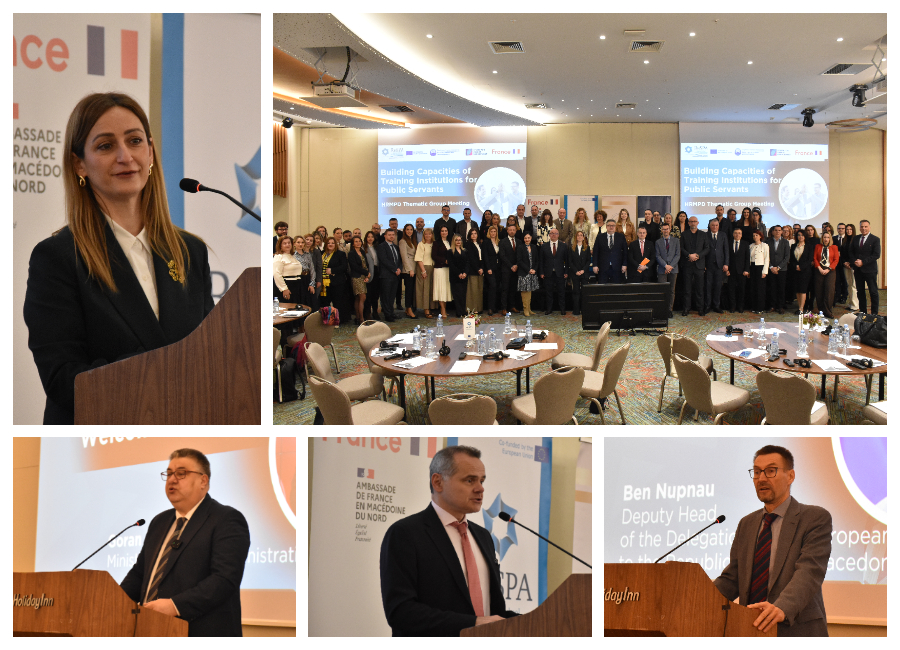
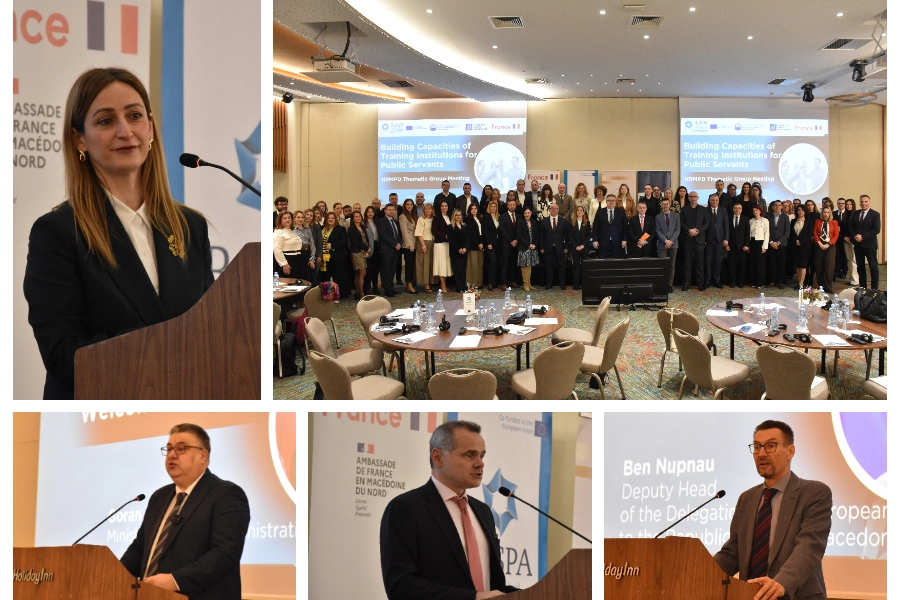
Senior representatives of public service training institutions, public administrations and international partners gathered in Skopje for the regional meeting “Building Capacities of Training Institutions for Public Servants,” jointly organised by the ReSPA, the Ministry of Public Administration of North Macedonia, the French Embassy in Skopje and the Centre for Change Management. The event provided a platform for peer exchange on how to strengthen training systems for public servants and support more professional, resilient and future-oriented public administrations across the region.
The meeting came at an important moment for North Macedonia, following the adoption of the new Law on Professional Development and Training of Administrative Servants, which foresees the establishment of a national Academy for Professional Development and Training of Administrative Servants within the Ministry of Public Administration. Participants explored how training institutions can be positioned to respond to evolving administrative needs, ensure quality and sustainability, and contribute to broader public administration reform and EU integration processes.
The opening session featured remarks by Goran Minchev, Minister of Public Administration of North Macedonia; Director Maja Handjiska-Trendafilova, Ben Nupnau, Deputy Head of the Delegation of the European Union to the Republic of North Macedonia; H.E. Christophe Le Rigoleur, Ambassador of France to North Macedonia; and Iskra Belcheva Ristovska, Programme Manager at the Centre for Change Management. Speakers highlighted the importance of partnership, coordinated reform support and investment in professional development systems that can equip public servants for increasingly complex governance challenges.
In her address, ReSPA Director Maja Handjiska-Trendafilova underlined “This gathering confirms ReSPA’s role as a regional hub and enabler of public administration reform. By connecting administrations, training institutions and partners across the region and the EU, we turn cooperation into concrete solutions. Peer learning enabled at this meeting is valuable support to the establishment of North Macedonia’s Academy - and exactly the kind of impact ReSPA is committed to delivering across the region,”
“Every seminar, every workshop, and every training session represents a step closer to an administration that is not a burden, but a true service to citizens. Only through strong human capital can we build a strong, modern, and European state,” underlined Minister Minchev.
French Ambassador Le Rigoleur stressed that “training civil servants is a cornerstone of sustainable public administration reform alongside with merit-based recruitment. By strengthening administrative capacity, we are not only supporting good governance but also contributing to our partners’ path toward closer integration with the European Union. France remains fully committed to this regional effort in the Balkans, working hand in hand with our partners to deliver tangible and lasting results.”
Mr Ben Nupnau, Deputy Head of the Delegation of the European Union to the Republic of North Macedonia, underlined that the establishment of the Academy for Professional Development and Training of Administrative Servants represents an important step in strengthening the professional development system for public servants and advancing North Macedonia’s EU accession agenda. He stressed that building a capable, professional and well-trained public administration is essential for meeting the standards of EU integration, implementing reforms effectively, and ensuring that public institutions are equipped to respond to the expectations of citizens and the demands of the accession process.
Over two days, the meeting addressed the full training cycle and institutional set-up of public service training providers. Discussions focused on training needs assessment, development of annual training programmes, induction training for newly recruited staff, managerial training, trainer selection and contracting modalities, remuneration and sustainability models, training methodologies, certification, quality assurance, evaluation, analytical capacities, digitalisation and cooperation with other training providers.
The programme brought together a wide range of experts from the region and the EU, including Peter Vandenbruaene and Mélanie Recour from the Federal Public Service Policy & Support of Belgium, Charlotte Duflos from the Lille Regional Institute of Administration in France, Sabrina Bandera from the National School of Administration of Italy, Valentina Miličić from the National School for Public Administration of Croatia, Stanija Višekruna from the National Academy for Public Administration of Serbia, Dafina Dodoveci from the Albanian School of Public Administration, Dalibor Ćopić from the Civil Service Agency of the Republika Srpska, Bosnia and Herzegovina, and Zemka Striković from the Human Resource Management Authority of Montenegro. Their contributions offered comparative perspectives on how training institutions can strengthen their governance, service quality and responsiveness to modern competency needs.
A World Café session on the second day enabled participants to move from exchange to problem-solving, identifying key challenges, good practices and priority support needs, with a particular focus on the newly established Macedonian Academy. The interactive format also helped capture common regional issues and practical ideas that can inform future support to training institutions in the Western Balkans and the Eastern Neighbourhood.
The meeting reaffirmed the shared commitment of ReSPA and its partners to support professional, merit-based and continuously learning public administrations, while strengthening regional cooperation and alignment with EU and SIGMA principles. The outcomes will help shape future activities under ReSPA’s Human Resources Management and Professional Development Thematic Group, as well as continued partner support for strengthening public service training systems in the region.