

Shaping Open and Digital Public Administration: Regional Forum on Common Priorities and Experiences
17–18 March 2026, Belgrade, Serbia
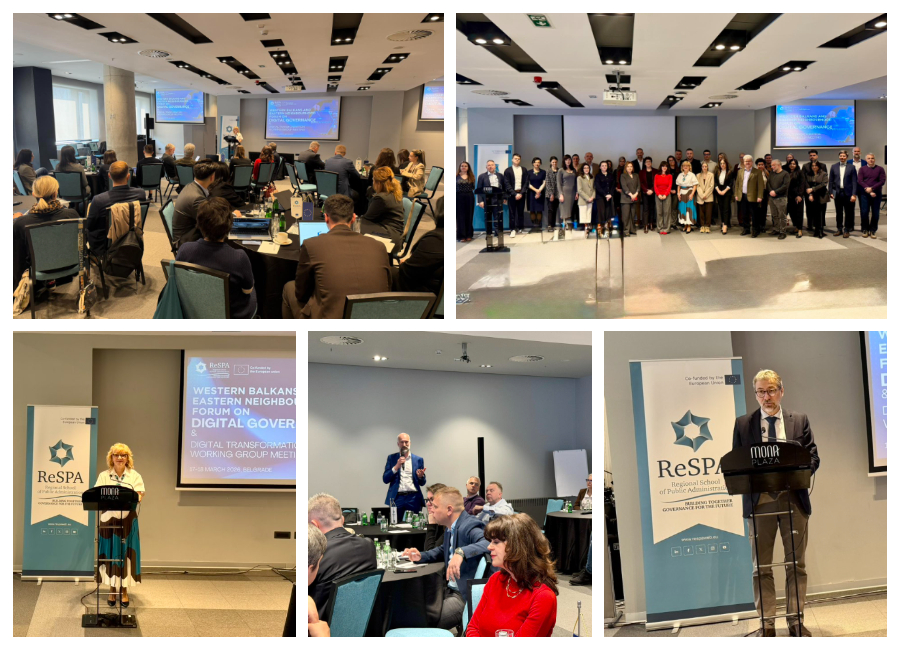
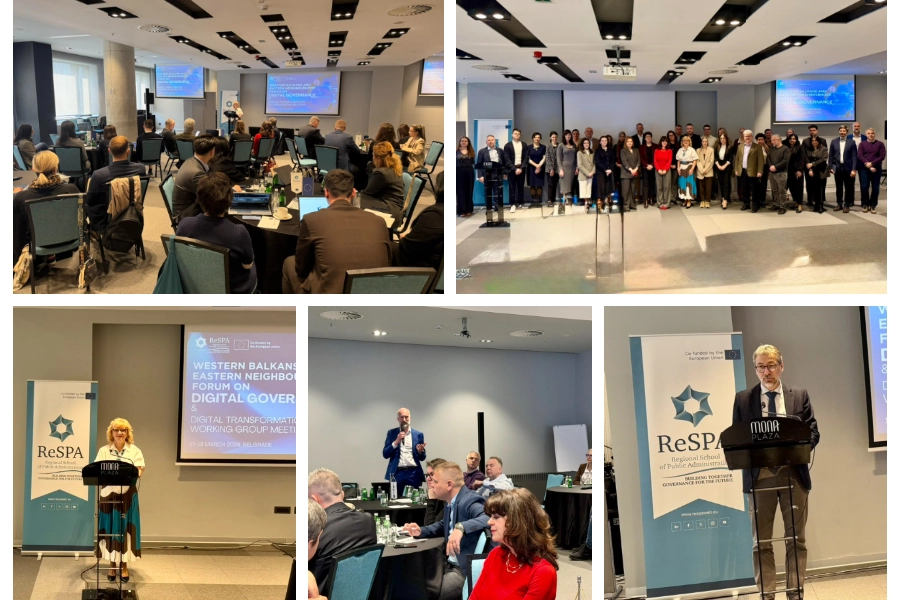
ReSPA brought together representatives of the Western Balkans and Eastern Neighbourhood for the Digital Governance and Open Government Forum and Digital Transformation Working Group Meeting to advance regional dialogue and practical cooperation at the intersection of digital transformation, transparency, and open government.
The two-day Forum served as a policy-to-practice platform to strengthen the link between open government commitments and digital transformation reforms, and to promote the use of data, digital tools, and artificial intelligence to enhance transparency, accountability, citizen participation, and public integrity in public administration.
Policymakers, practitioners, Open Government Partnership contact points, Digital Transformation Working Group members, and international partners reflected on common priorities and exchanged experiences on building more open, inclusive, and innovative public administrations.
Mr Mauro di Veroli from the EU Delegation to Serbia, Ms Sandra Pernar (Open Government Partnership), and Ms Bojana Bajic (ReSPA) set the stage for discussions on regional digital transformation and open government priorities.
Mr Mauro di Veroli opened the Forum by highlighting the EU’s continued support to digital transformation and open government reforms in the Western Balkans, emphasising the importance of transparency, institutional capacity, and alignment with EU standards
Ms Sandra Pernar set the stage from the Open Government Partnership perspective, underscoring the critical role of open government principles in ensuring that digital transformation delivers greater accountability, citizen participation, and trust in public institutions
A keynote speaker, Mr Samo Zorc, elaborated on the evolving role of artificial intelligence and open data in modern public administration, while the keynote speaker, Mr Luukas Ilves, provided forward-looking perspectives on agentic AI and the future of digital government.
The first day, dedicated to Strategic Alignment and Policy Frameworks, focused on how open government reforms can be better aligned with digital transformation agendas. In the session “Aligning Open Government and Digital Transformation Reforms,” Mr Ales Veršić explored regional and global trends, the synergies between open government and national reforms, and links with the legal framework, while participants discussed the main challenges and opportunities in this evolving field.
Participants got acquainted with the ReSPA Programme of Work and Support, highlighting the organisation’s role in supporting public administrations in advancing digital governance and accountability.
A session on “Digitalization of Making & Monitoring Open Government Commitments” led by Ms. Sarah Kennedy, focused on digital governance and public sector transformation, shedding the light on digital co-creation, including the use of open parliament platforms, online consultations, and e-participation tools to design more inclusive and transparent commitments, as well as digital monitoring and reporting systems that help track progress, publish updates, and strengthen accountability in implementing OGP Action Plans.
The Forum turned to open data as a foundation for transparency and participation, where Kennedy examined the transition from political commitment to institutional action, with a focus on ensuring sustainable open data publication in practice. Contributing to the session, Mr Aleš Veršić presented the Slovenian experience in data stewardship and the establishment and coordination of a network of data stewards in the public sector, while Ms Andreja Gluščević shared insights linking open data and citizen engagement. Discussions encompassed the institutional mechanisms, coordination frameworks, and the practical conditions needed to advance open data reforms across administrations.
The final session of Day 1, “Citizen Participation in the Digital Age,” featured Miloš Đinđić, Program Manager and Senior Researcher at the European Policy Centre (CEP) who addressed digital tools for active citizen participation, with particular attention to the design, functionalities, and key aspects of public consultation portals in the Western Balkans, providing a regional perspective on how technology can support more meaningful public engagement.
The second day, focused on Innovation, AI, and Practical Implementation, shifted attention from strategic alignment to concrete governance models and practical tools. A session on “Artificial Intelligence for Transparency and Public Integrity – Governance and Policy Frameworks,” led by Mr Samo Zorc, examined how AI can support transparency and integrity while requiring sound governance and clear policy safeguards.
Mr Luukas Ilves led the session “Agentic AI and Open Government: Shaping the Next Generation of Digital Governance,” exploring how AI-driven, autonomous systems can transform public administration by enabling more adaptive, proactive, and citizen-centric services, while emphasising the need for strong governance, transparency, and human oversight
Followed by the session “Artificial Intelligence for Transparency and Public Integrity - Practical Use Cases and Implementation,” delivered by Ms Sarah Kennedy, who focused on how AI can be operationalised in the public sector to support improved decision-making, monitoring, and service delivery.
A session on “Data Governance, Trust and Accountability,” led by Mr Aleš Veršić, guided participants through discussions on data stewardship and data spaces, highlighting the importance of trust, accountability, and responsible governance in the use and sharing of public-sector data.
Mr Ales Veršić and Mr Samo Zorc jointly lead the session “From Strategy to Implementation,” focusing on the framework of data strategy and the development of an action plan for open data, supporting participants in translating strategic concepts into more actionable approaches for implementation within their administrations.
The final session, “Education, Cooperation and Next Steps,” moderated by Bojana Bajić from ReSPA, explored opportunities for continued regional capacity building, stronger peer exchange through the Digital Transformation Working Group, and better use of ReSPA’s Knowledge Management Platform as a regional repository of key transparency and accountability platforms.
The Forum reaffirmed ReSPA’s commitment to supporting administrations in building digital governance systems that are not only innovative but also transparent, participatory, and accountable to citizens.