

Italian Expertise and Regional Ownership Drive Forward Public Administration Reform in Bari
28-30 April 2026, Bari, Italy
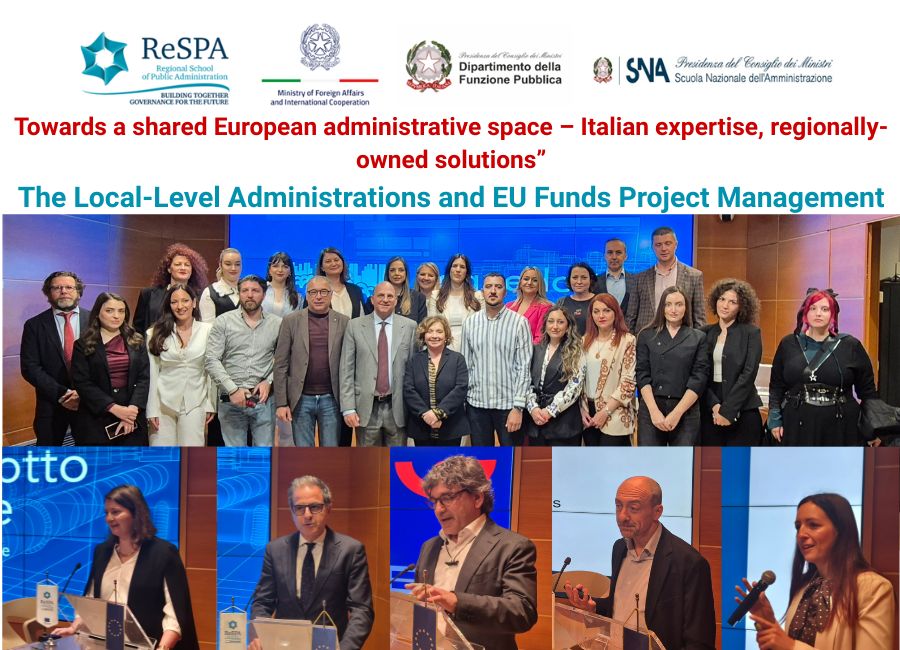
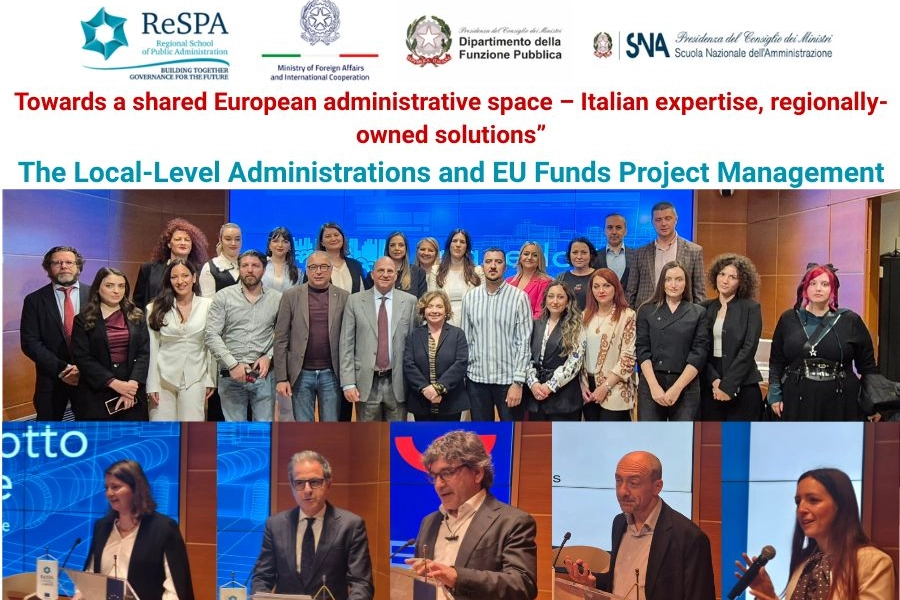
The 3rd Cycle of the Public Servants’ Capacity Building and Mobility Programme 3.0 has started with the Local-Level Administrations and EU Funds Project Management stream, in Bari, Italy, bringing together public officials from across the Western Balkans and Italian institutions.
Hosted at the headquarters of Acquedotto Pugliese in the Puglia Region, the three-day programme combines hands-on learning, peer exchange, and expert-led sessions, reaffirming the shared commitment to strengthening administrative capacities and fostering a common European Administrative Space.
Mr Roberto Venneri, Chair of the Board of Directors of Acquedotto Pugliese, set the stage for an in-depth exploration of EU-funded project management at the regional and local levels. Representatives of the Puglia Region shared concrete case studies, offering participants direct insights into the implementation of EU-funded initiatives.
Key topics included the organisation and functioning of European project services at the provincial level, presented by Carmelo Calamia, as well as migration policies and the use of European financial instruments, discussed by Vitandrea Marzano. Strategic management of water resources was highlighted by Andrea Volpe, showcasing large-scale infrastructure and sustainability projects, while Marina Muserra provided a comprehensive overview of audit authorities and control systems under the 2021–2027 programming framework.
The first day concluded with a high-level session led by David Natali, who introduced the rationale of EU Cohesion Policy and the National Recovery and Resilience Plan (NRRP), offering participants a broader understanding of the strategic framework guiding regional development across the European Union.
The second day focused on the practical implementation and future direction of European Territorial Cooperation in the Adriatic region. Dea Hrelja guided participants through lessons learned from previous programming periods and outlined expectations for the upcoming 2028–2034 cycle, emphasising the importance of cross-border collaboration and strategic alignment. Later on, Alessandro Valenza, delved into the common indicators and monitoring systems under the EU framework, addressing the logic, definitions, and quality assessment mechanisms essential for effective programme evaluation. Participants engaged in discussions on how to strengthen monitoring practices and ensure measurable impact in public investments.
The final day shifts focus towards performance-based approaches, exploring how monitoring systems evolve into “pay-for-performance” models in the next multiannual financial framework. This forward-looking perspective equips participants with tools to better align project implementation with EU standards, ensuring accountability, efficiency, and tangible results.
Organised in partnership with the Italian Ministry of Foreign Affairs and International Cooperation and the Italian National School of Administration (SNA), and implemented by ReSPA, the programme builds on a strong foundation of the previous two editions while advancing into a more focused, impact-oriented phase.
The Bari module is one of three core thematic streams of the 2026 programme, followed by advanced modules on Leadership Development and Digital Transformation, delivered in Rome and Caserta.
The Leadership Development stream will bring together senior public managers to reflect on their evolving roles in complex administrative environments. Sessions led by experts such as Barbara Quacquarelli and Luca Solari will explore leadership in public organisations, the balance between performance and legitimacy, and the growing importance of self-awareness, organisational politics, and strategic influence.
In parallel, the Digital Transformation module will provide an in-depth look at Italy’s advanced digital governance ecosystem. Participants will engage with leading experts, including Caterina Flick, Mauro Iacono, and Giancarlo Sperlì, covering topics such as the Digital Administration Code, artificial intelligence in public services, cybersecurity frameworks, cloud strategies, and national digital platforms like pagoPA.
By combining Italian expertise with regionally-owned solutions, the programme continues to strengthen professional networks, enhance administrative capabilities, and support the Western Balkans in aligning with EU standards.
As the programme progresses across its three thematic streams, it reaffirms a long-term vision: building resilient, future-oriented public administrations capable of delivering better services to citizens and contributing meaningfully to the European Administrative Space.