

Ireland for EU Enlargement Programme Launches Second Cohort, Expanding Regional Leadership Network for EU Accession
2-4 June 2026, Dublin, Ireland
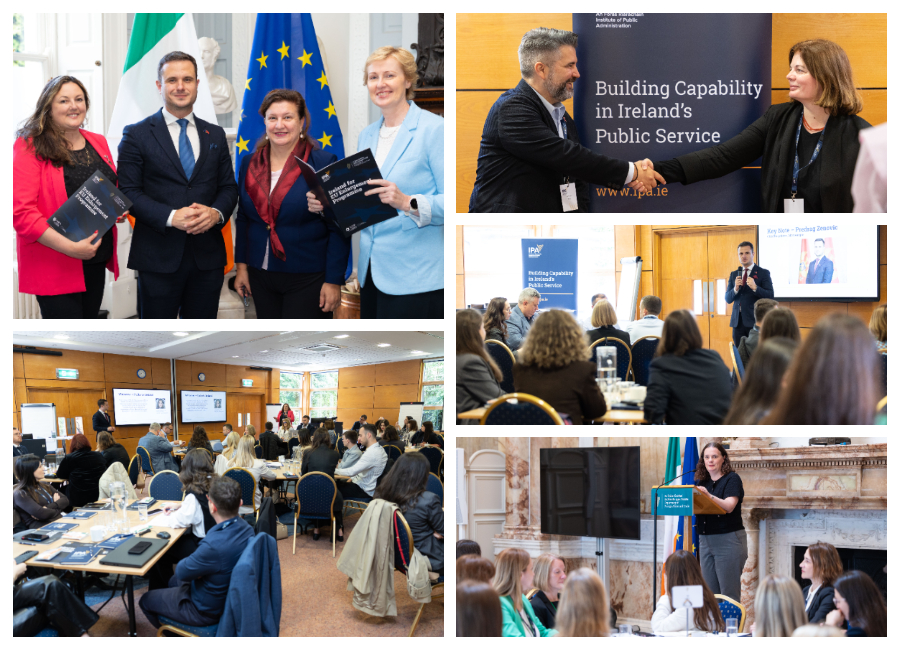
The second cohort of the Ireland for EU Enlargement Programme officially commenced this week in Dublin, bringing together public servants from across the Western Balkans, Moldova, and Ukraine to strengthen leadership capacities essential for navigating the complexities of the EU accession process.
Funded by Ireland’s Department of Foreign Affairs and Trade and delivered by the Institute of Public Administration (IPA) in partnership with ReSPA, the three-year programme is designed to support public servants working at the forefront of enlargement by developing the leadership, collaboration, and problem-solving skills required to drive reform and deliver meaningful change.
Building on the success of the pilot phase, which brought together participants from Albania, Moldova, Montenegro, Ukraine and ReSPA, the programme enters its expansion phase in 2026, welcoming representatives from Albania, Bosnia and Herzegovina, Kosovo*, Moldova, Montenegro, North Macedonia, Serbia, Ukraine and ReSPA. The second cohort marks an important step in creating a broader regional community of practice dedicated to EU accession and public sector transformation.
The launch programme opened with introductory remarks and a deep dive into the concept of the “Accession Mindset” and the role of leadership in driving reform. Participants explored how EU accession is not merely a technical exercise but a leadership challenge that requires navigating complexity, working across institutional boundaries, and translating reform ambitions into practical outcomes.
A key highlight of the opening days was engagement with Irish institutions and policymakers. Participants took part in roundtable discussions with representatives of Ireland’s Department of Foreign Affairs and Trade at Iveagh House, gaining valuable insights into Ireland’s experience of EU membership and its preparations for the 2026 Presidency of the Council of the European Union.
The programme also featured “Technical Safaris” to leading Irish institutions, including the Criminal Assets Bureau, the Central Bank, and the Revenue Commissioners, offering participants first-hand exposure to Irish public administration practices and institutional leadership.
Throughout the programme, participants engaged in one of three technical streams aligned with key EU accession priorities: Justice, Rule of Law and Governance; Economic Institutions and Competitiveness; and Digital Transformation of Government. These streams translate accession requirements into practical reform actions and provide opportunities for peer learning and collaborative problem-solving.
The Dublin launch also introduced participants to the programme’s distinctive boundary leadership approach, which equips public servants to lead across institutions, systems, and sectors rather than relying solely on formal authority. Through leadership development workshops, technical exchanges, and the innovative “Big Dilemma” module, participants worked together on complex, real-world challenges linked to EU enlargement and institutional reform.
More than a training programme, the Programme is designed as a growing community of practice that fosters trust, collaboration, and long-term professional networks across enlargement countries. By bringing together leaders facing similar reform challenges, the initiative aims to strengthen the leadership capacity needed to make EU accession practical, effective, and sustainable.
The second cohort will continue its learning journey through technical workshops, leadership development activities, and collaborative projects until the Capstone and Closing Conference, to be held in Moldova in September 2026.
As the programme enters its expansion phase, it reinforces a shared commitment to preparing public administrations for the challenges and opportunities of EU enlargement - creating leaders who are better connected, better equipped, and better prepared for what comes next.