

Building Integrity, Preventing Corruption: Three Masterclasses for Stronger Public Administration
ReSPA and the Italian National School of Administration (SNA), within the third edition of the Capacity Building and Mobility Programme funded by the Italian Ministry of Foreign Affairs and International Cooperation, delivered three online masterclasses aimed at strengthening public servants’ knowledge and capacities to understand, prevent and address corruption. The sessions were part of the programme’s special integrity module, “Anticorruption: Understanding, Preventing and Managing Corruption.”
Held on 14, 21 and 28 October 2026, the masterclasses were organised within the “Public Servants’ Capacity Building & Mobility Programme 3.0”, under the overarching theme “Towards a shared European administrative space – Italian expertise, regionally-owned solutions.” The sessions were delivered by experts from Italy’s National School of Administration (SNA), Giovanni Tartaglia Polcini and Valentina Donini.
The first masterclass, held on 14 October, focused on the international anti-corruption framework. Participants explored key international legal instruments, including the United Nations Convention against Corruption (UNCAC) and the OECD Anti-Bribery Convention. The session addressed key areas such as prevention, criminalisation of corruption-related offences, international cooperation, asset recovery and corporate liability.
The second masterclass, held on 21 October, examined the nature of corruption, its different forms and its wider implications for society. Topics included the distinction between petty and grand corruption, administrative and political corruption, and the economic, social and democratic consequences of corrupt practices, including their impact on inequality. Participants also explored approaches to measuring corruption, including perception-based indicators and experience-based surveys, with particular attention to the strengths and limitations of different indices and rankings.
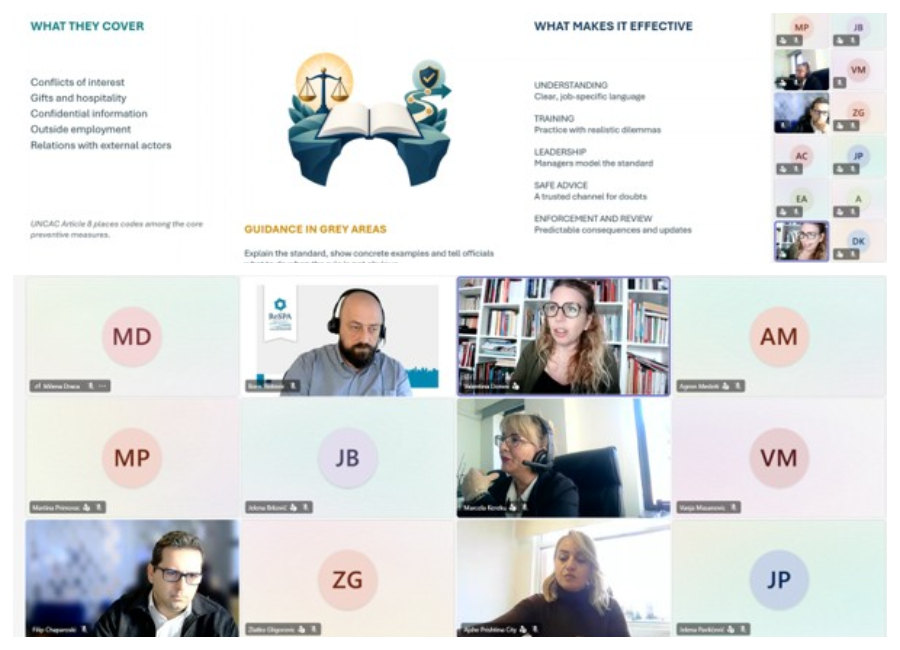
The third masterclass, held on 28 October, focused on prevention tools and integrity management in public administration. Participants examined practical mechanisms for strengthening institutional integrity, including transparency, whistleblowing, codes of conduct and conflict-of-interest management. The session also highlighted the distinction between preventive measures and enforcement mechanisms in the broader effort to address corruption.
Boris Ristović, ReSPA Programme Coordinator, underlined at the closing: “These practical inputs from the Italian anti-corruption experts are very valuable for ReSPA and our beneficiaries. Our work with the Community of Practice on Public Sector Integrity provides an additional perspective on how corruption prevention measures could be applied in practice. In addition, the expert support reiterates the importance of continued strategic cooperation with EU Member States and Italy, as one of the most valuable partners. Such peer exchanges and transfer of practical experiences is exactly the added value that ReSPA brings to its beneficiaries, within the context of EU Enlargement."
Together, the three masterclasses provided participants with an opportunity to deepen their understanding of international anti-corruption standards, the challenges involved in identifying and measuring corruption, and the practical tools available to promote integrity in public administration. The topics addressed are particularly relevant to building transparent, accountable and trustworthy institutions and strengthening public servants’ capacity to apply integrity principles in their day-to-day work.