

Closing Module of the Regional Academy on Evidence-Informed Policymaking Marks Renewed Regional Commitment to Transparent, EU-Aligned Governance
4-6 November 2025, Tirana, Albania
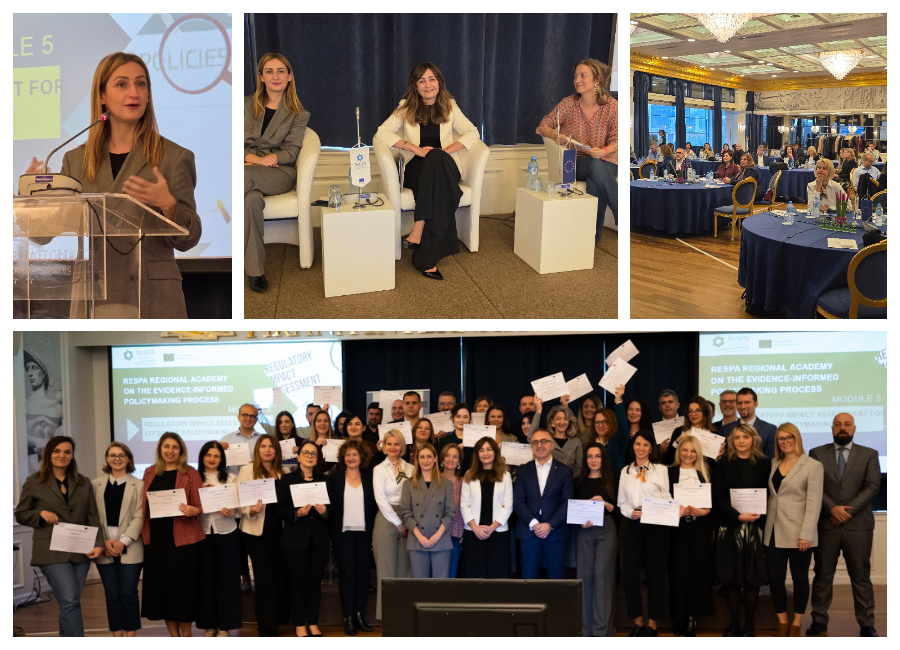
ReSPA hosted the final and fifth module of its flagship initiative — the Regional Academy on Evidence-Informed Policymaking - titled “Regulatory Impact Assessment for Effective Policymaking.” The closing event marked the culmination of a three-year regional journey dedicated to strengthening policymaking capacities across the Western Balkans.
Launched in 2022, the Academy has been at the heart of ReSPA’s efforts to advance more efficient, transparent, and EU-aligned policymaking. It has brought together representatives of national governments, academia, and regional policy experts to foster peer learning, cross-border cooperation, and practical engagement. Through its five modules, the Academy has become a genuine regional platform where theory meets practice — and where knowledge is transformed into action.
The fifth module focused on the Regulatory Impact Assessment (RIA) framework - a cornerstone of transparent, evidence-based policymaking. Its main objectives were to:
- Present the RIA framework and its relevance in both Western Balkan and EU contexts.
- Offer hands-on training in developing RIA reports.
- Encourage peer learning and regional collaboration among RIA practitioners.
The three-day module brought together participants from line ministries, policy coordination bodies, and other governmental institutions, including mid- to senior-level professionals engaged in the design and evaluation of public policies.
Opening the event, ReSPA Director Maja HANDJISKA-TRENDAFILOVA reflected on the significance of this long-term initiative: “We began this journey in October 2022 in Novi Sad, exploring the foundations of policymaking and the full policy cycle. Since then, the Academy has taken us across the Western Balkans: to Bar for monitoring and evaluation, to Mostar for policy–budget links and gender budgeting, and to Ohrid for digital and data-driven policymaking. Today, in Tirana, we conclude with Regulatory Impact Assessment — a key element of transparent, efficient, and EU-aligned policymaking.”
Fotjona TAÇE, Chief of Cabinet, Ministry of State for Public Administration and Anti-Corruption, Albania emphasized the Academy’s impact, underlining that the Academy stands as a platform where theory meets practice - where policymakers learn, collaborate, and shape the future of governance in the Western Balkans, underlining that RIA is important not only for the effective policy making, but for the culture of transparency.
In her address, Valerie ČOVIĆ, Programme Manager at the European Union to Albania, highlighted the importance of aligning the region’s policymaking practices with European standards, placing particular emphasis on the RIA framework as a key instrument of EU-oriented governance.
A keynote speech was delivered by Bojana BOŠKOVIĆ, State Secretary at the Ministry of European Affairs of Montenegro, who spoke about “The Importance of RIA for Evidence-Based Policymaking and the EU Integration Process.”
Other notable speakers and experts included:
- Bagrat TUNYAN, Senior Policy Advisor at SIGMA/OECD, who presented insights from the 2024 SIGMA Monitoring Reports on RIA implementation.
- Štěpán RŮT, Government Counsellor at the RIA Unit of the Czech Republic, who shared best practices and lessons learned from EU Member States.
- Dr. Lorenzo ALLIO, ReSPA Expert, who led in-depth sessions on RIA methodology and implementation across the EU.
- Dragana ALEKSIĆ, ReSPA Expert, who guided participants through practical group exercises in RIA development.
The module combined keynote sessions, interactive workshops, and case studies, giving participants a chance to apply RIA methods in real policy contexts. They worked in teams to draft RIA reports, present findings, and receive constructive expert feedback — translating theory into practical skills.
Through the Regional Academy, ReSPA has cemented its role as a driving force for evidence-based policymaking in the Western Balkans. By harmonising policy planning methods, fostering regional cooperation, and encouraging the practical use of analytical tools like RIA, the Academy supports governments in their efforts to align with EU standards and improve the quality of public policies.
The event featured a certificate ceremony, marking the successful completion of this multi-year learning journey — and celebrating a shared regional commitment to more effective, transparent, and data-driven governance.
Jelena MRDAK, ReSPA Programme Manager, concluded the event by saying:: “Looking ahead, our ambition must be to move from formal compliance to effective use: RIAs should be prepared early, cover all relevant regulatory options, assess the full range of impacts, including economic, social, budgetary, environment, and be transparently published and debated — thereby strengthening our policymaking, enhancing public trust, and accelerating our journey to full EU membership.”
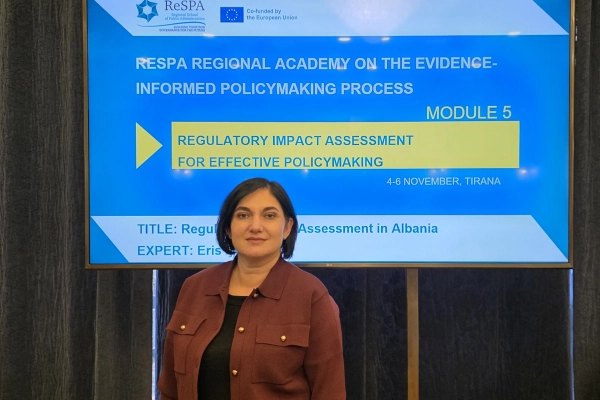
ReSPA Academy – A Platform for Regional Cooperation and Professional Growth The ReSPA Academy stands out as a unique regional platform that brings together expertise and capacities in integrated strategic planning, policy development, coordination and other key areas related to public administration.
It provides a valuable space for learning, networking, and the exchange of best practices among colleagues from across the region, while also drawing inspiration from European Union experiences.
By connecting civil servants from different Western Balkan administrations, the Academy has built a strong professional community. Through various learning formats, presentations, and interactive sessions, it has helped strengthen regional cooperation and supported the individual professional development of all participants.
I am especially proud that, through the Mobility Scheme and in close cooperation with colleagues from the General Secretariat of the Government of Montenegro, we successfully organized a study visit for representatives from the General Secretariat of the Government of North Macedonia. This joint initiative between the two Secretariats created new opportunities for direct communication and the exchange of good practices and experiences in strategic and sectoral planning, as well as in the areas of cooperation, alignment, and coordination.
I strongly believe in the future of the ReSPA Academy and in its potential to evolve into an even more advanced format—one that will continue to open new opportunities for strengthening administrative capacities across the region and encouraging significant regional initiatives.
Katerina Krsteska
State Advisor for coordination of the planning and policy monitoring,
General Secretariat of the Government of the Republic of North Macedonia